Posts from April 2026

Retournant chez nous

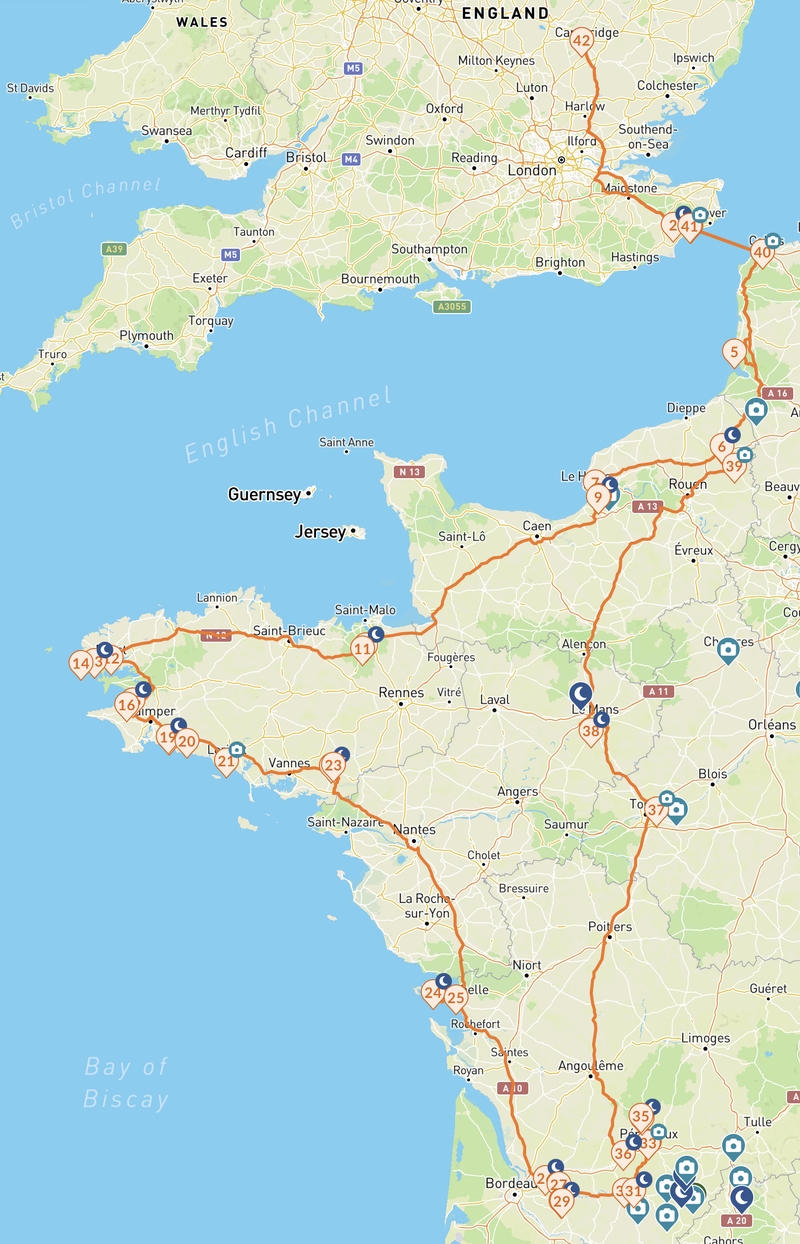
Well, at 1am on Saturday morning, we arrived home from our 'Tour de France' in the campervan. We had planned to travel for a bit longer, but having stayed in 15 different places for our first 17 nights, we were in danger of overload and so decided to turn for home and save some of the other places for a future trip! One of the joys of campervan travel, and especially in France, and even more so in France outside the peak season, is that you don't need to book anywhere in advance, and so can make the trip up as you go along, and change it on a whim. But we had a lovely time and clocked up nearly 2000 miles on the lovely, smooth, quiet French roads.

france_trip_map_2026

Some of our destinations were chosen for literary reasons. We love Neville Shute, and wanted to see Brest, Douarnenez, and the submarine pens at Lorient, mostly because they feature in his books. A fondness for Alexendre Dumas, and the references in The Three Musketeers to the Isle de Ré, and the siege of La Rochelle, added those locations to the list. As a fan of Shakespeare's Henry V, I am still looking forward to a future visit to Agincourt, but we did go once more unto the breach, dear friends, in Harfleur: it's now a roundabout, called La Brèque, at the place where the breach in the old city wall used to be!

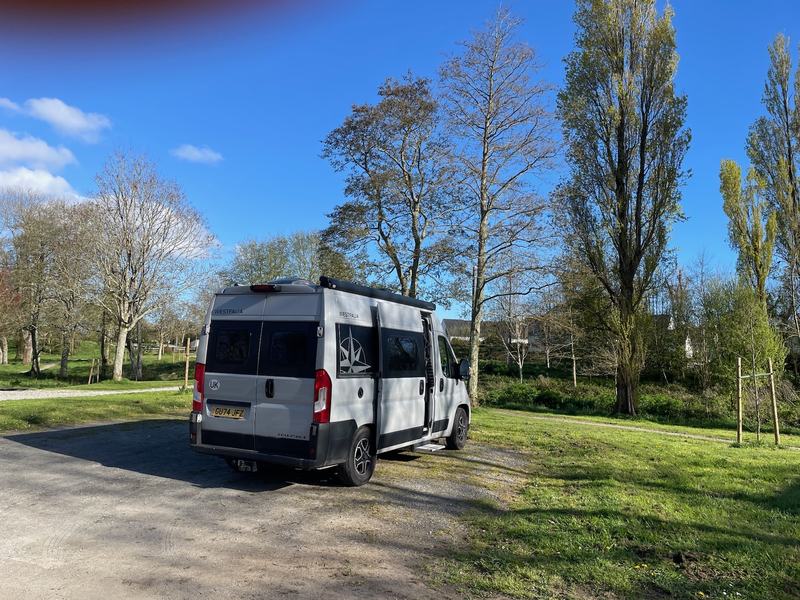
We visited harbours and grottos, lighthouses and cathedrals, beaches and Roman villas. We stayed mostly on campsites, but sometimes at an Aire de Camping-Car, which, for the uninitiated, is a parking area where a local authority allows you to stay overnight, often for free. There are huge numbers of these in France, often in small villages, and they encourage visitors to visit local shops and restaurants. We now have warm fuzzy feelings about a little village named Locmaria-Plouzané, in the Finisterre region, of which we would otherwise have been completely ignorant, simply because they kindly let us pass a very peaceful night here, a short walk from the village centre:

Locmaria-Plouzané aire

Very few British authorities are this enlightened, though CAMpRA, the Campaign for Real Aires, is working to get more aire-like facilities in the UK, and we've stayed on a couple of delightful ones.

Some French aires provide a few more services and require modest payment. Some are privately owned: we stayed at a lovely one in the Dordogne that was surrounded by a wire mesh fence with a sliding gate, and the owners asked us to make sure it was closed at night. I was surprised... I looked around at the rolling farmland and thought it didn't look like a high-crime area. No, no, they explained, the gate was to keep any local wild boar out so we weren't disturbed in the night...

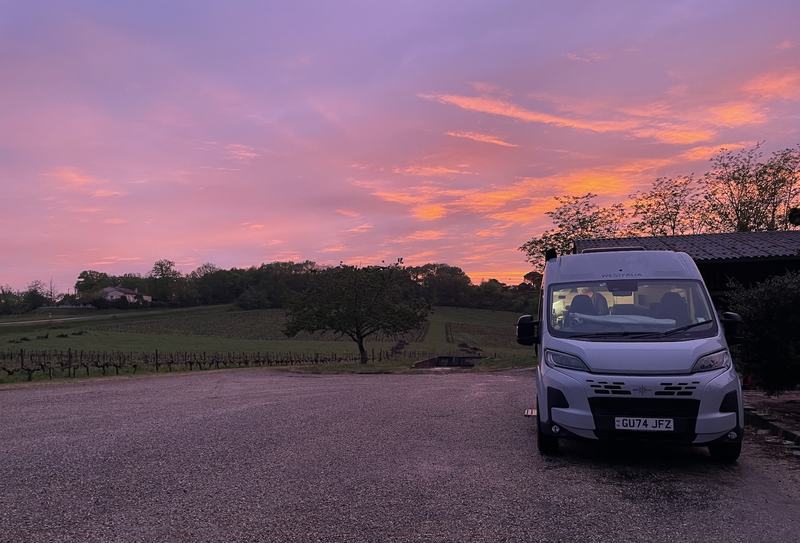
We spent one night, for free, in a vineyard, courtesy of the France Passion scheme.

Chateau Coustolle Vignobles

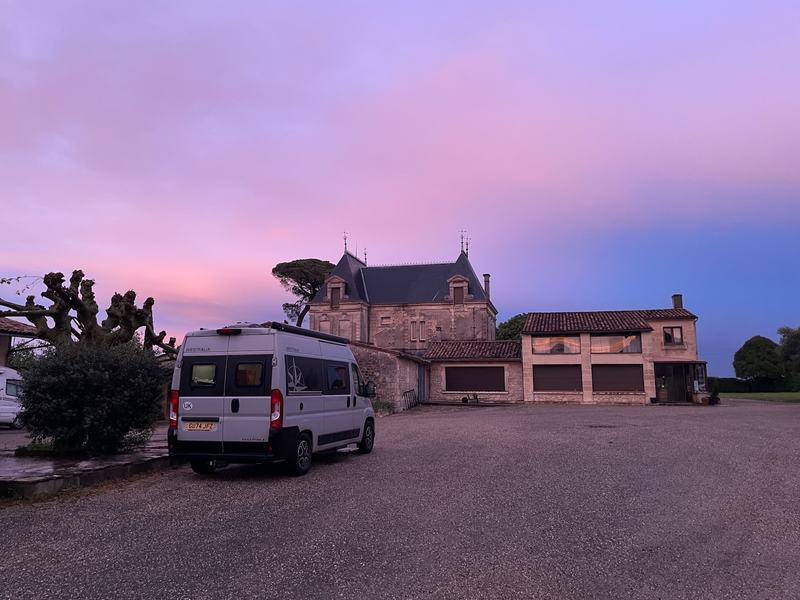
Complete, of course, with a small chateau...

Chateau Coustolle Vignobles

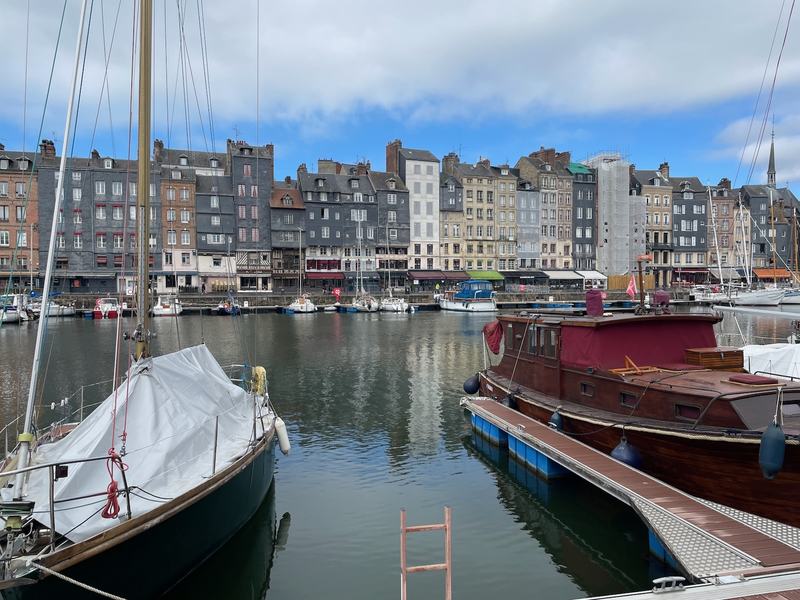
And in Honfleur we stayed in what was basically a large car park... but which was absolutely peaceful at night, provided an electric hook-up, and was 5 minutes' walk from the wonderful old harbour.

Honfleur vieux bassin

For those contemplating the relative comforts of a car park and a hotel room, it must be admitted that our ensuite facilities in the van are somewhat compact. But we also have the benefit of sleeping each night in our own bed, with our own pillows and duvet, and our clothes conveniently in the cupboards without a suitcase in sight.

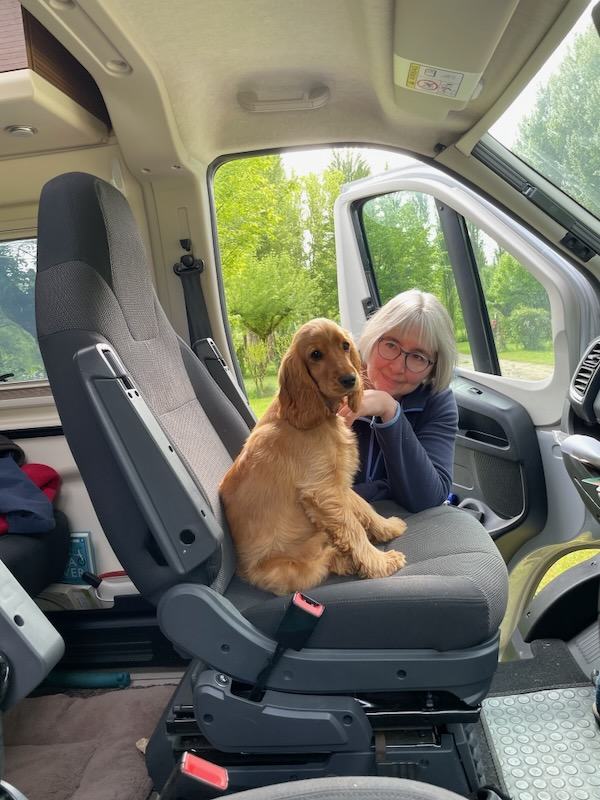
Our range of activities was a little constrained on this trip by the presence of Betsy, our five-month old puppy. At one point we came back to the van to find she'd realised the view was better from Rose's seat than from the floor. Bother. I fear this means we'll now have to purchase some seat covers...

Betsy on the van seat

Anyway, we're now back, and have tamed the jungle that just three weeks ago was our nicely-mown garden, so I can soon get round to editing my many hours of video footage into a YouTube video, which I do, primarily, to help me relive the trip and remember it for longer!

I feel the need, the need for (just a bit less) speed

Well, yesterday's post got a lot of responses! Thank you, everybody!

Some of them are visible in the comments and some were by email. But most of them were from drivers rather older than me who said that my formula would have them driving at 40 on motorways (or something like that).

Now, notice that I did talk about the maximum speed you like driving rather than the maximum speed you would consider driving, but clearly I have more high-velocity octogenarians amongst my readership than I had previously realised, for which I feel duly honoured.

Ian Clark suggested an amendment which was essentially

Vmax = 103 - (age * 2 / 3)

which would still suit me and give older readers a few more mph to play with, but I think I'll need an exponential component to get anything reasonable, perhaps something more like:

Vmax = 100 - 0.6 *age0.95

Anyway, there was agreement from several readers that the desire to break the speed limit certainly decreases with age, and Andy Davy observed that toddling along at 50mph is often fine as long as you have an interesting podcast playing; an assertion I can definitely support. In my case, though, it's often an audiobook: we're currently touring France to the accompaniment of The Count of Monte Cristo. (I'm now contemplating my next theorem about the duration of any journey being inversely proportional to the quality of your listening material...)

All this reminds me of, in my younger days, getting stuck in completely stationary traffic on the M25 while heading for an airport to catch a flight. The minutes ticked by, my anxiety rose, and then I realised that the pumping drumbeat of my music probably wasn't helping. I replaced it with some nice Brahms cello sonatas, and, all of a sudden, my equanimity was restored, my blood pressure declined, and I gazed calmly at the surrounding vehicles (about which I could, in any case, do nothing). And yes, I arrived in plenty of time.

I feel the need, the need for (less) speed

When we started towing a boat behind our car, and were consequently limited to 60mph rather than 70mph on major roads in the UK, I found I rather liked travelling that way. Yes, it took a bit longer, but it was more relaxing.

And I've noticed that, whether due to a growth in wisdom or to a decline in testosterone -- I prefer to think it's the former -- I now tend to drive rather more slowly than I did a decade or two ago. Rose suggests I may just be subconsciously aware of slower reaction times...

But this has led me to propose Quentin's Law of Optimal Velocity, which is the maximum speed in miles per hour at which you like to drive, and is given by:

Vmax = 120 - age

but I freely admit that this is based on a rather small sample size (errm... one, to be precise) so would be grateful for more data.

Does it correspond to your own experience?

We'll rant and we'll roar

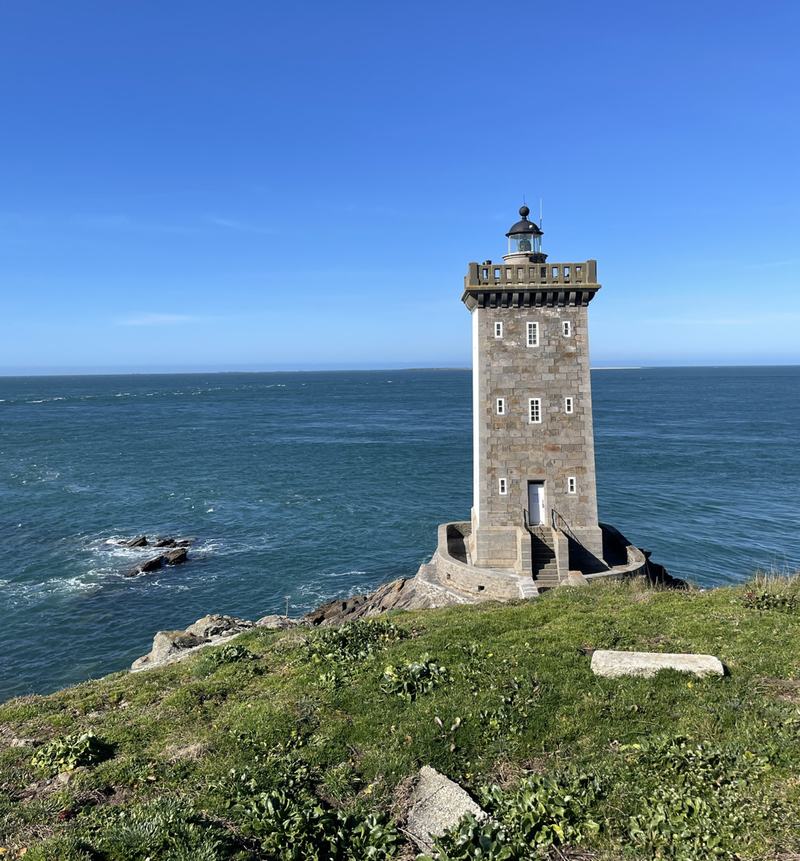
Kermorvan Lighthouse

This morning, we visited Kermorvan Lighthouse, just across the river from the delightful Le Conquet.

This is the most westerly point of mainland France, on a delightful headland, and definitely worth a visit, especially if you're lucky enough to get the kind of weather we had today.

By the way, from here to the Scilly Isles is a little over 100 miles. How do I know this without looking it up?

Well, slightly off to the right (not visible in this photo) we could just see another lighthouse on the horizon: on the island of Ushant, about 15 miles offshore.

And as all good sailors know, when you've had to say farewell and adieu to those fair Spanish ladies, adieu and farewell to those ladies of Spain, because you're under orders for to sail to old England, then you'll come past this point on the way.

You'll probably rant and you'll roar, like true British sailors, and you'll rant and you'll roar all on the salt seas, 'til at last you strike soundings in the channel of old England (and Ushant to Scilly is thirty-five leagues).

A retiring sort of chap...

Well, here's an announcement...

The day before yesterday, I retired.

Not a particularly exciting announcement for my readers, but, as you can imagine, a fairly significant one for me! Though it's a rather black-and-white statement for something which in fact involves rather more shades of grey. I decided that a binary transition from not-retired to retired was perhaps not entirely healthy, and so nearly two years ago, I informed my consultancy clients that I'd like to retire about now, and I've been gradually reducing my workload since then, until I was down to just one or two days per week.

I definitely recommend this approach, if you can do it. For one thing, it gave me confidence that I wasn't going to have any trouble filling my time when I was no longer working. And secondly, during that period, we've been living pretty much on the budget we expect to have in retirement, and have found it quite doable. Both of these make the transition much less scary than it might otherwise be!

If you had told me, in my youth, that I might retire before I even hit 60, I would have been surprised. I have always enjoyed my work, and been blessed with some great jobs and splendid colleagues, so I had no particular desire to leave that world behind. I've also spent most of my 'career' in start-ups or in junior part-time academic posts, which has made for a more modest income than that enjoyed by many of my friends, and correspondingly smaller pension contributions, never quite benefitting either from big corporate schemes or the (also often rather generous) ones enjoyed by many full-time long-term academics. So I assumed early retirement would be unaffordable for me.

But when it became apparent a few years back, to my surprise, that it was a real possibility, without either excessive luxury or frugality, I started to think about the trade-offs between time and money. I have always had many more hobbies than I have time to spend on them, and much as I've always enjoyed my work, I enjoy doing some of these even more! So I started doing a lot of reading, and YouTube-watching, on the subject of early retirement and retirement finance planning. Some of these had comments from people saying things like, "I retired in my early 50s and I'm so glad I did!", which made me feel a bit less decadent about considering it at my rather more advanced age.

There was also a persuasive argument I read somewhere that went roughly along these lines: If you retire in your mid-to-late 60s, as many people do, the chances are that you'll have 10-15 years of reasonable health; maybe rather more, if you're lucky. But if there are two of you, and you want to do things together, the probability that both of you will be fit and healthy drops significantly: perhaps the balance of probabilities might put it closer to 10 years. There's an acronym I've seen used by pension advisers: JOMY, which is short for the rather common 'Just One More Year' syndrome: "I'm going to retire very soon, but I think I'll give it just one more year before I do." If you consider that every 'just one more year' might take 10% of the time you have to enjoy significant retirement activities with your spouse... well, you can do the maths.

Anyway, all of the above explains, to some degree, why we are now in our little campervan, in unexpectedly glorious sunshine, just a short walk from the charming old harbour of Honfleur on the Normandy coast. And we're doing something which I've always wanted to do: leaving home for a vacation without knowing exactly when you'll be coming back...