Category: Gadgets & Toys
Time's Wingèd Chariot
The best chat-up line ever invented has to be the poem To His Coy Mistress, by Andrew Marvell, where, in 46 lines of glorious verse, he explains to his girl that they really do need to get down to some hanky-panky, because they won't always be able to do so, and time is running out. Extended courtship and foreplay is all very well, he argues,
But at my back I always hear
Time's winged chariot hurrying near...
I was thinking of this as I created my first app for my Pebble watch today, inspired by a combination of a 17th-century poet and my friend Richard, a 21st-century technologist. He held a party a little while ago to celebrate being one gigasecond old, and has a nice web page where you can check your age, too.
So, since part of the idea of the Pebble is that you can personalise it to a great degree, I thought that a watch face that showed my age in seconds would be a good project. I named it 'Tempus Fugit'.
But then it occurred to me that one could also do the opposite - a countdown. How long I've been around is an interesting topic, at least for me. But how long I've got - well, that's even more compelling!
Of course, life expectancy is a highly personal thing (and one wishes to avoid the estimation errors made by the Rich Fool in the parable) but it's interesting to speculate. Life expectancy, in statistical tables, tends to be quoted as 'expectancy at birth', based on an assumption that mortality rates will continue through your life at the same kind of level as they were at your birth. When I was born, in 1967, it was about 69 years in the UK. It's now 78, according to Wikipedia, and will no doubt continue to rise. So on the one hand, one might expect that the inferior healthcare, nutrition advice etc in my youth would mean that I probably come somewhere between the two. On the other hand, today's figure doesn't take into account the improvements in healthcare that are inevitable in the future, which may mean that my allotted span may be more that the expectancy of those born today (as will theirs).
So, as a rough estimate, averaging these two factors, I decided to use the present life expectancy for the UK, currently around 78 for men and 82 for women. (It's slightly more in Canada and Australia, and a couple of years less in the U.S.).
And so, with a minor variation in the software, I now have two new watchfaces for my Pebble. The first, Tempus Fugit shows how many seconds I've been alive. The other shows my best estimate of how many I've got left, a number which is already distressingly lower than the first, and, of course, counting down...
Some may think this morbid. But I prefer to think of it as an inspiration... a call to action.
Oh, and in case I should be short of ideas about what to do with the time that remains, I named this second one Time's Wingèd Chariot. I think Marvell would approve.

I may be celebrating a rather different kind of gigasecond soon!
Any colour, so long as...
Looking at the collection of gadgets on my bedside table makes me wonder whether I'm dull and unimaginative, or stylishly coordinated...

(For the curious, the three similar-looking devices on the right are my Kindle, iPad, and iPad mini. I don't normally need them all in the same place at once! The thing on the left is my GPS logger and the watch is, of course, a pebble.)
Digital Doppelganger

I've always liked the idea of a telepresence robot -- a video-conferencing device that you can move around a remote location to give you a more tangible presence there -- but suspected the number of really practical uses of these very expensive devices was somewhat limited.
So I was struck by the great story of Grady Hofmann featured in the latest BBC Click episode. Grady, an eight-year-old, was able to chat to his siblings in their bedroom, go to his school, and take his place at the family dinner table, all while he was confined to a hospital bed for 2 months during a bone-marrow transplant. OK, I thought - this stuff is worthwhile after all!
Double Robotics are creating a neat low-cost telepresence robot which uses an iPad as the face, eyes, ears and speaker, and Segway-type mobility. All for under $2000 (plus iPad) which means these are starting to be affordable. (The whole device would cost about the same as 4 months' rail commute from Cambridge to London.)
There are two issues I think these devices still need to tackle, though. The first is that they need the ability to connect themselves to a charging device, to reduce their dependence on other people. The Roomba can do this, so it should be manageable.
But the second is something that may be rather more tricky. I know this because it took the Daleks fifty years to come up with a solution.
Recherche du temps
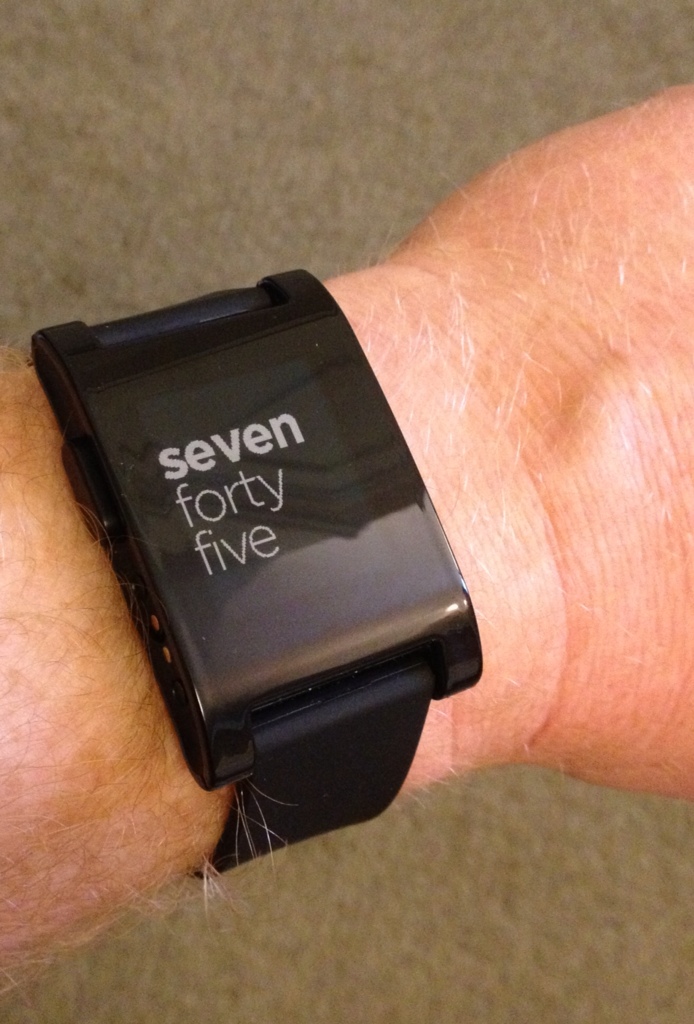 About a year ago, like many thousands of others, I backed the Pebble Kickstarter project. Yesterday, after forking over another 25 quid to the Queen (a combination of the Royal Mail and Her Majesty's Revenue and Customs), I received my new toy.
My first impression was that it looks and feels much nicer than I expected. It's hard to convey this in pictures: I don't think it looks as cheap in reality as the black shiny plasticness of many photos would suggest, and after years of a fine but heavy stainless–steel–and–titanium Citizen, this feels light and comfortable.
At present, there's a limited amount you can do with it. Incoming texts and iMessages are forwarded to it, incoming calls can be accepted or rejected from your wrist, and you can stop or start music and skip backwards and forwards. But there's a buzz of activity on the forums around the newly–released SDK. In just a couple of days, people have contributed range of new watch faces, and, of course, there's already a Tetris and a Pong clone!
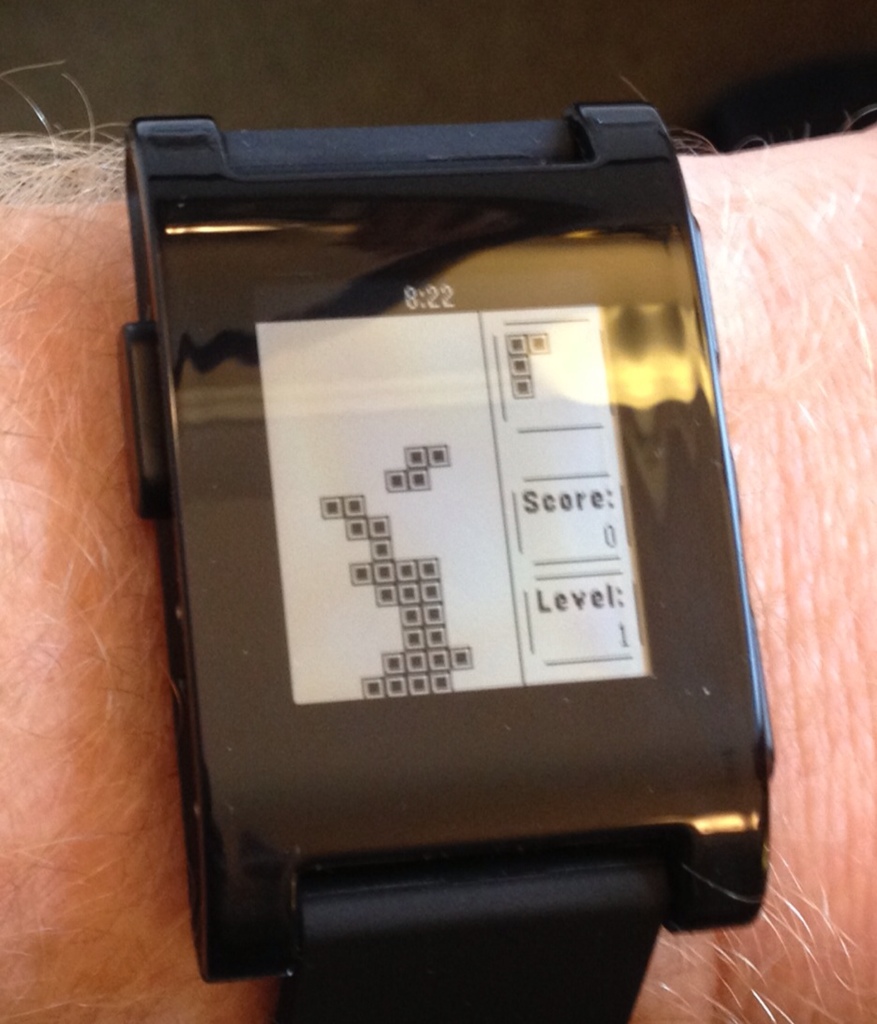 The really interesting apps, though, will depend on the watch's connectivity with your phone, and thence with the outside world. I must have a play with the SDK soon, but I suspect the facilities offered by the phone's Bluetooth APIs will be the limiting factor there, especially on my iPhone.
In the meantime, the ability to stop and start playback of my audiobooks and podcasts is very handy. I tend to put my phone in my breast pocket while walking the dog, so I can listen to things without the need for headphones, but this can make me look a little eccentric to passers-by. Appearances can be deceptive. So being able to stop the audio as someone approaches, simply by pressing a watch button, helps preserve my dignity.
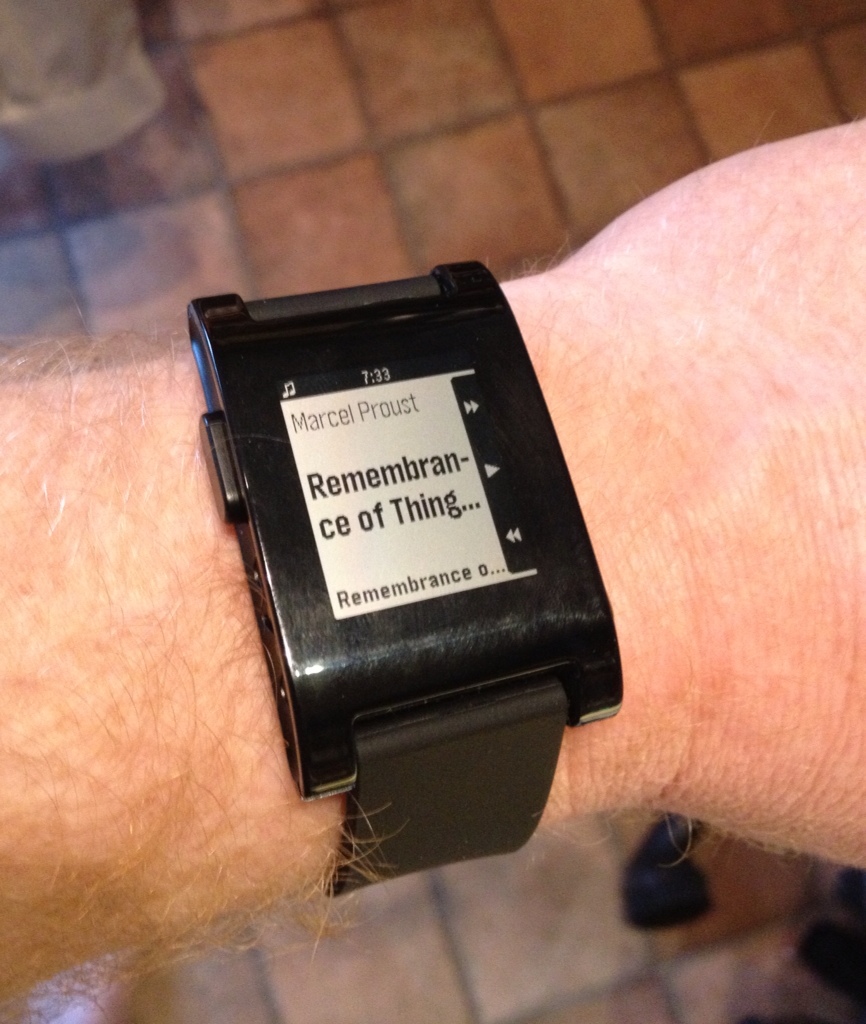 At present, I'm listening to a splendid version of Proust's À la Recherche du Temps Perdus. It seems somehow appropriate.
But I think it's time for a new translation. The title is typically rendered in English as 'Remembrance of Things Past', or -- and this is perhaps poignant for those exploring their watch's user interface -- 'In Search of Lost Time'.
But my upcoming version will be a whole new translation of À la Recherche du Temps Perdus for the modern age, entitled, "In Research, Much Time is Wasted"...
Wait a minute, Mr Postman
My friend Rob Berwick sent me a kind gift of a Blinkstick. Here's an example of what you can do with it, in this case, by plugging it into a Raspberry Pi.
You can get the Blinkstick as a kit, and solder it together yourself (which isn't difficult) or, for a few quid more, get it ready-assembled.
Some links to other things mentioned in the video:
Alas, poor PC... I knew him, Bill...
An IDC press release, out today, reports that PC sales have fallen again. That's expected now, but they've fallen noticeably faster than predicted: the last quarter was a surprising 14% down on the same time last year.
"At this point, unfortunately", says an IDC staff member, "it seems clear that the Windows 8 launch not only failed to provide a positive boost to the PC market, but appears to have slowed the market..." And it's not just Windows – Apple's desktop/laptop sales are down, too.
A big contributor, I'm sure, is that we've finally reached the point where operating system manufacturers and other software developers can no longer convince users that it's worth buying a new machine just to run their latest offerings. I'm currently a software developer, for heaven's sake, and even I am feeling no particular desire to replace my four-year-old iMac in the near future.
But a lot of it also comes from the fact that fewer people need to do, on a regular basis, what PCs were designed to be good at doing.
Phones and tablets don't replace a PC, but if you drew a Venn diagram of
- What PCs do
- What mobile devices do
- What people do
over the last few years, it would resemble a lapsed-time animation of plate tectonics. And my point is that 'What PCs do' would be largely stationary, while the others moved around it in ever-more-overlapping zones...
I write quite a lot, but I use a word-processor about once a month. I manage my company accounts, but much more of that is done on a web service than on a spreadsheet. I give talks, but the days when PowerPoint was the only game in town are long gone. And I read emails... while I'm walking the dog.
So, if I'm at all typical, where does that leave Microsoft Office, the core of most PCs' raison d'être? And remember, I'm an old guy. For most people under the age of 25, it probably never was that important. The office suite is dead, and has been for a long time. Long live the browser. On whatever device.
On which note, I should shut down the browser on this iPad and go to sleep...
Thanks to Charles Arthur for the IDC link

The iPad will be my undoing
Gosh, it's easy to miss this one:
Finding the Undo and Redo keys on the iPad
I've been using the vigorous-shake-to-undo feature when I'm working in apps which don't have an Undo button, but it isn't always convenient. Especially late at night when I'm trying not to wake Rose...
The Googlehome?
My friend Frazer points out that the manufacturers of screen wash fluid had better start looking for a new business, because, with self-driving cars, we soon won’t need windscreen wipers. And with no rear-view mirrors, where will we hang the fluffy dice? Actually, Frazer has some keen insights into the massive changes that driverless cars will eventually bring to society.
Richard and I, discussing our hopes for this future, realised that what we really wanted was a driverless campervan or motorhome. Just imagine, you can all sit around and have a cup of tea en route. Or, if you prefer, a glass of wine. And then go to bed. And in the morning, you wake up in the Alps and take the dog out for a walk. If you need a car, to get around while you’re there, you can call one to wherever you’re parked. But if you have a car of your own, and you want to take yours along, you can just tell it to follow you there.
Now, this is an important new market, because one of the things that driverless cars will bring is dramatically-reduced car ownership. Cars sit idle in the street for so much of the time, just so that they’re around when you need them. But when an iPhone app can call any nearby car to you at any time, they’ll be much more efficiently used, and you’re much less likely to need one of your own. Having to find parking in city centres will be a thing of the past, and residential streets will be freed of so much clutter. All good news.
Unless, of course, you’re a car manufacturer. If car ownership goes down by a factor of two, three, four… who knows?… you’ll need a new source of revenue. And I think your motorhome/campervan, decked out the way you like it, is a very personal thing - it’s something you’ll still want to own. And something a lot more people will want to own in this future.
So I’d like to offer my services as a consultant and beta-tester for Google, and all those auto manufacturers, who are now slapping their foreheads as they realise that… of course! The key to their future is in the mobile, self-driving, holiday cottage…