Making our home network even more secure?

We awoke this morning to find that our internet connection was offline.  I did a range of diagnostic tests and came to the conclusion that the problem was with the fibre network outside our house, rather than with anything on the inside.  

We get our broadband from EE. This is a re-badging of BT's service, and it's cheaper than BT if you happen to have any EE SIMs in any of your devices, because then they can call it a package and give you a multi-service discount.  Anyway, I sent them a text, they called me back very promptly, we went through some more diagnostics and they agreed that an engineer needed to come out, and could do so tomorrow.

It was only later that I thought I might walk around the outside of the house and just see if there was any obvious damage to the fibre.  And I discovered that some local security consultant, probably with a bushy tail, sharp teeth and a fondness for nuts, had decided to secure our network by making it properly air-gapped from the outside world.

Mmm.  I can't imagine that two inches of optical cable made for a very tasty meal...  though perhaps he read Dennis Burkitt and is a great believer in the importance of dietary fibre.

Doesn't quite fit at the Fitz...

One of the great things about living in Cambridge is having free and easy access to the Fitzwilliam Museum: an enormous building with a great collection of art, sculptures, ceramics... even the building itself is worth seeing, both inside and out.  It's far more than most towns of our fairly modest size could hope for, and we visit it regularly.

I also like to take visitors down the narrow Fitzwilliam St opposite to see a discreet plaque on the wall of no. 22: "Charles Darwin lived here, 1836-7". He came to Cambridge after he returned from his voyage on the Beagle, and I like to think that he was writing up his notes here and might have stayed for longer, if he hadn't been disturbed by the building work just starting across the street for the museum.

Anyway, we enjoyed our latest visit with friends on Saturday, but I'm afraid the Fitz has gone a bit 'woke'... and I'm not someone who often uses that pejorative word.  

The little descriptive cards alongside all the paintings have been replaced recently, and now they are keen not so much to tell you about the brush technique, the unusual use of light, and the influence of other artists, as to make socio-political points.  You know the kind of thing: everything men do is bad and everything women do is good.  When rich people are portrayed, they are ostentatiously displaying their wealth.  When they create anything beautiful, we must remember that lots of poor people suffered in order for them to do so.  When poor people are shown, if they are sad, we can see the oppressive circumstances under which they lived, and if they appear to be happy or content, that is because it's an unrealistic idyll showing how divorced the painter was from the harsh realities of the time.  

Some of which, of course, may be true, but is it really the role of an art gallery to display all these wonderful creations and then tell you how bad you should feel about them?  Perhaps they're concerned about the threats from narrow-minded protesters with a taste for vandalism, and hope to deflect their ire by mentioning slavery and oppression and misogyny quite a lot.  Anyway, it has clearly been a recent policy decision of the current management, and I think it's a pity.

But do go and visit anyway, and enjoy the exhibits!  It's worth it, and you'll have a good time if you don't read too many of the descriptions.  And the cafe is nice too.

What did the Buddhist say to the hot-dog vendor?

This is an old joke, but I've only just heard it.

"What did the Buddhist say to the hot-dog vendor?"

"Make me one with everything."

And then, somebody's later addition...

The hot-dog vendor makes him his hot-dog with all the trimmings, and says, "That'll be $7.50."

The Buddhist reaches into his saffron robes, extracts a $20 note, hands it over, and starts eating. The vendor turns to the next customer... but the Buddhist interrupts him. "What about my change?"

The vendor is unperturbed.

"Change comes from within."

Fake (AI) News

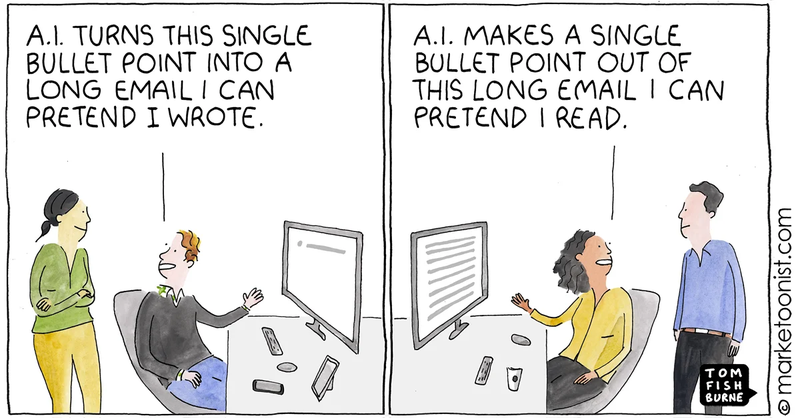
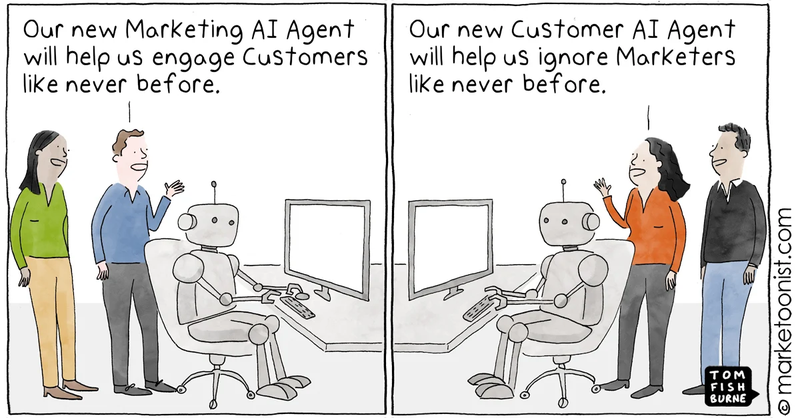
It appears that we still need to keep publicising the cautionary tales around AI, because people aren't getting the message.  I was very concerned, when reading an online forum recently, to see somebody raise a (serious) health-related question, to which some other helpful person replied with many paragraphs of information pasted straight from ChatGPT.  Don't do this, people!

Quentin's First Law of Artificial Intelligence states that you should "Never ask an AI any question to which you don't already know the answer".  (Because it will make major errors. Frequently.  And you need to be able to spot them. Especially if they're advising you on medical matters!)

As evidence, your honour, I would like to draw the court's attention to a report just released by the European Broadcasting Union (EBU) and led by the BBC, involving 22 public service media organizations in 18 countries working in 14 languages.

The News Integrity in AI Assistants Report was an extensive piece of work, and here are some of the key findings when they asked the four primary AI assistants about a large number of news stories, and carefully analysed the answers:

  • 45% of all AI answers had at least one significant issue. (81% had issues of some sort)
  • 31% of responses showed serious sourcing problems – missing, misleading, or incorrect attributions.
  • 20% contained major accuracy issues, including hallucinated details and outdated information.
  • Gemini performed worst with significant issues in 76% of responses, more than double the other assistants, largely due to its poor sourcing performance.

The fact that Google's Gemini was the worst performer is worrying since the 'AI Overview' that often appears at the top of Google searches must be one of the most common ways ordinary users see AI output now.

"And yet, many people do trust AI assistants to be accurate. Separate BBC research published at the same time as this report shows that just over a third of UK adults say they completely trust AI to produce accurate summaries of information. This rises to almost half of under 35s. That misplaced confidence raises the stakes when assistants are getting the basics wrong."

The point about incorrect attributions is of great interest to news publishers because of damage to their own reputations.  When AI systems invent facts, they often attribute them to real organisations, and

"42% of adults say they would trust an original news source less if an AI news summary contained errors, and audiences hold both AI providers and news brands responsible when they encounter errors. The reputational risk for media companies is great, even when the AI assistant alone is to blame for the error."

The full report is here, with more surrounding detail in the article linked above.  It includes some nice examples of the types of problems.

Some are as simple as information being out of date. When asked, a little while after Pope Leo was elected, "Who is the Pope?", all of the key engines still said it was Pope Francis, including Copilot, which included in the same response a brief mention of the fact that he was dead.   When asked "Should I be worried about the bird flu?", it claimed that a vaccine trial was currently underway in Oxford.  The source was a BBC article from nearly 20 years ago.

Another example response included material from Radio France claiming it was from The Telegraph, and didn't appreciate that the segment it quoted was actually from a satirical broadcast...

The one light at the end of the tunnel is that things have improved a little bit from the last (smaller) study that was done.  But it's a long tunnel.  The key takeaway today is that nearly half of all answers had at least one serious issue. And nearly a half of under 35s say they completely trust AI summaries.

Thanks to Charles Arthur for the link.

Reverting to the mean

When I'm the ruler of the world, I'm going to decree that all online rating systems are required, at least once a year, to recalibrate all of their existing scores based on a normal distribution bell curve.

Then the most common rating will be 3 out of 5, which will represent the average and will not be a source of any shame, and scores of 5 (or 1) will be reserved only for the truly exceptional.

It'll save us from the daft situation of trying to pick a restaurant that has a score of 4.7 over one that only gets 4.6...

Not so grim up north!

Autton Bank

We've just returned from a somewhat spontaneous tour of northern England in our little campervan, which we cunningly timed to coincide with the unexpected arrival of Storm Amy. As friends and family sent us links to the orange weather warnings, we looked in vain for campsites named something like 'Sheltered Glade', and instead always found ourselves in places whose names contained phrases like 'sea view' or 'high moor'!

But all was well, and we had a splendid time despite the weather, which calmed down after our first few days. One of the joys of making such trips out of season and during school terms is that you can very much play it by ear: we often left one location in the morning without being entirely sure where we were staying that night, and in the end we had a good mix, from pub car parks, to peaceful fields, to fully-equipped campsites.

In all, we slept in eight different places over nine nights, and yet always in our own comfortable bed, with our own pillows, under our own warm duvet. A good campervan is a marvellous thing.

We visited grand houses...

...and rugged castles.

We might have lunch at sea level on one day...

and at Britain's highest pub on another.

Tan Hill Inn

We admired the colours of Teesdale waterfalls...

Low Force waterfall

and of Burne-Jones windows.

We also did some more touristy things. Being fans of James Herriot, we enjoyed a visit to the lovely little village of Askrigg, one of whose prominent buildings was used as 'Skeldale House' in the original BBC TV series of All Creatures Great and Small.

And, though it sounds a little corny, the World of James Herriot museum in Thirsk is exceedingly good, and well worth a visit if you know the stories.

So now, after rural picnics and fine restaurants, art galleries and abbeys, motorways and farm tracks, big cities and picturesque villages...

...we are now back home in a very flat East Anglia, which does seem, now I think of it, to have rather a shortage of castles and waterfalls.

I'm already looking forward to the next trip.

Freedom of the press

Imagine an inkjet printer that you could repair yourself, and where you were actually encouraged to refill the cartridges!

That's the aim of the Open Printer project.

If the idea of printing from a roll of paper seems strange, you need to know that it incorporates a cutter too, so you can print single pages, and you're not restricted to one size of paper.

If, like many of us, you don't print very much these days, wouldn't it be nice to get the printer off your desk, and hang it on the wall?

I think this is a splendid idea, and I've signed up for updates (even though we already have three large printers in the house!)

I really hope they succeed.

Where the rubber meets the road...

I have a theory, which I'd like to expound, and my clever readers can tell me whether it's right or wrong.

It came to me in the mid-1980s, this theory, when I got my first car: a Hillman Imp, which I purchased for £90. It had no manuals, and, actually, no ignition key: you had to put an old screwdriver into the slot where the ignition switch had once been, and twist it to start...

Anyway, because I had no documentation, I just guessed at the appropriate pressures for the tyres, and pumped them up to 30 PSI all round. Several months later, in mid-winter, I finally found out that the front of the Imp was so light that the front ones were only supposed to be at 16 PSI. This, I imagine, accounted for the fact that when it was snowing, turning the steering wheel didn't do very much on its own, and I had to make handbrake turns to get around some of the tighter corners on my daily commute.

And this came back to me, a quarter of a century later, when I got my first electric car: a BMW i3, which had large and very narrow tyres -- almost like motorbike wheels -- to improve the airflow..

Some of my friends and neighbours said they'd prefer bigger, fatter tyres so there would be more rubber in contact with the road.

But I pointed out that, to a first approximation, this shape didn't make any difference. And here's my reasoning:

The thing keeping your car off the ground is the air pressure in the tyres pressing on the patch of tyre that's in contact with the road. That downward force must equal the pressure in the tyre times the area of contact. Or, to put it another way, if your tyres are at 40psi and your car weighs 2000 lbs, then you must have roughly 50 sq. ins. in contact with the road - 12.5 sq ins per tyre - whatever your shape of tyre.

So, for the same pressure and weight of vehicle, if your tyres are wide, you'll get a wide, short patch touching the ground. If they're narrow, you'll get a longer, thinner patch, but they should be about the same size in either case. Double the pressure, and you'll halve the area in contact with the ground. Halve it, and you'll double the area. But buying wider tyres will only make you look more macho.

Now, this is an approximation, partly because tyres aren't perfect spherical balloons and the area doesn't change smoothly with the pressure, partly because the forces go towards stretching the rubber as well as supporting the car, and partly because the pressure is providing rigidity to the structure of the tyre, so you get some support from the vertical bits of rubber as well, but the basic principle holds: it's primarily the pressure, not the shape of the tyre, that's important in determining how large an area touches the road.

Now, in practice, I came to rather like the long, thin tyres of the i3: they cut through water and slush very well, and were less likely to aquaplane when you encountered a puddle. (A counter-argument, I guess, would be that if there's a rut on the road, you're likely to have a higher proportion of your tyre on it for longer if your contact area is long and thin.)

So, yes, the best way to get a better grip is generally to lower the pressure, if you can face the resulting fuel costs. However, even this isn't as simple as it may seem, because you may remember from your school physics lessons that it's the perpendicular force times the coefficient of friction that counts; Guillaume Amontons showed in the 17th century that if you're sliding two surfaces over each other, the area of contact isn't important - it's the force with which they're being pressed together.

If we had perfectly flat roads, increasing the area in contact with the ground would make little difference. But sadly, the roads are getting ever less flat around here, so dropping the pressure a bit will not only get you a better grip as winter approaches... it'll make the potholes more comfortable too.

Up North and Down South

Campervan in the early morning, with Lindisfarne behind.

Back in late February, while Rose was away, Tilly (may she rest in peace) and I departed on one of our campervan trips. As is often the case when I'm doing these out-of-season jaunts, I set off not really knowing where I would end up, my itinerary being driven partly by the weather forecast, and partly just by a desire to see places I'd heard of but never visited before.

It ended up being a tour mostly of north-east England and south-west Scotland, and I captured rather a lot of video footage over the two-week trip, which I've finally managed to edit into something watchable! Watchable for me, anyway: I do this mostly to give me a chance to relive the experience many times over, and I also make the videos available just in case they're also of interest to others.

Dalcairney Falls

The first part of that certainly works very well: the long reviewing and editing process means I have detailed memories of several of my past trips where there would otherwise be just a vague, hazy recollection. (It also means that the videos are rather longer than if I were making them for someone else!)

But as for the second part -- will others watch them too? -- well, I appreciate that there are many people, probably most people, for whom the idea of watching extended video footage of other people's holidays may be a bizarre concept, but there are also a surprising number who do get enjoyment from this kind of thing... especially other campervan & motorhome owners who might be looking for places to visit or stay on their travels.

Over the years I have built up an extensive set of custom lists on Google Maps with titles like 'Want to go' and 'Overnight stop?', which have proved very handy when planning any kind of trip, and many of the little markers they contain have come from watching others' videos and thinking, "Oooh. That looks rather good...Let me just mark that...".

Anyway, I've now uploaded the first few episodes to a YouTube playlist called Up North & Down South, and the remainder will follow over the next couple of days, in the hope that, as someone once said, "people who like this sort of thing will find this the sort of thing they like".

First episode here.

It's not too late to avoid paying for AI...

Back in January I wrote about how Microsoft had increased their Office subscription prices by a third, but you could still get it for the old price by saying that you wanted to cancel, and then selecting the 'Microsoft 365 Family Classic', which comes without all of the AI features that lead to the extra cost.

Well, our subscription just came up for renewal... and I found that they've now removed that option from the website. In fact, there's nothing on the website to suggest that writing a letter without the aid of AI is something you might want to do... or appreciating that you might not want to pay for it.

Undeterred, though, I used the online chat system. It was AI, of course, but, to be fair, I was able to get through to a human pretty quickly. She had some standard auto-generated responses about all the wonderful things AI could do for me, and a set of questions she needed to ask me about why I didn't want AI to improve my productivity in my Office suite. I said, roughly:

  • (a) It costs money.
  • (b) I'm concerned about the environmental impact.
  • (c) Im concerned about the privacy implications.
  • (d) I've used the the tools, and know that the supposed productivity improvements are mostly a myth unless you're writing stuff that nobody would want to read... in which case, why bother?
  • (e) We went to school, so we already know how to write.

I could have added that:

  • (f) I almost never use Microsoft Office, so wouldn't look there for any of this stuff anyway, and
  • (g) Modern Microsoft apps are quite bloated enough without wanting to add anything more, and
  • (h) The only things I might want to use AI for I can get for free from chat.bing.com or chatgpt.com or aistudio.google.com or claude.ai, so I'd rather spend my 25 quid on fish and chips and beer at a nice waterside pub, thank you very much.

But even without those additions, in the end she admitted that she could actually renew my Microsoft 365 Family Classic subscription for the old price.

So it's still possible, if you can manage to talk to a human. But I wonder for how much longer...