Inebriated cephalopod
I love this photo, posted on Facebook recently by Mark Littlewood.

Quentin Stafford-Fraser's blog
One should always have something sensational to read on the net...
I love this photo, posted on Facebook recently by Mark Littlewood.
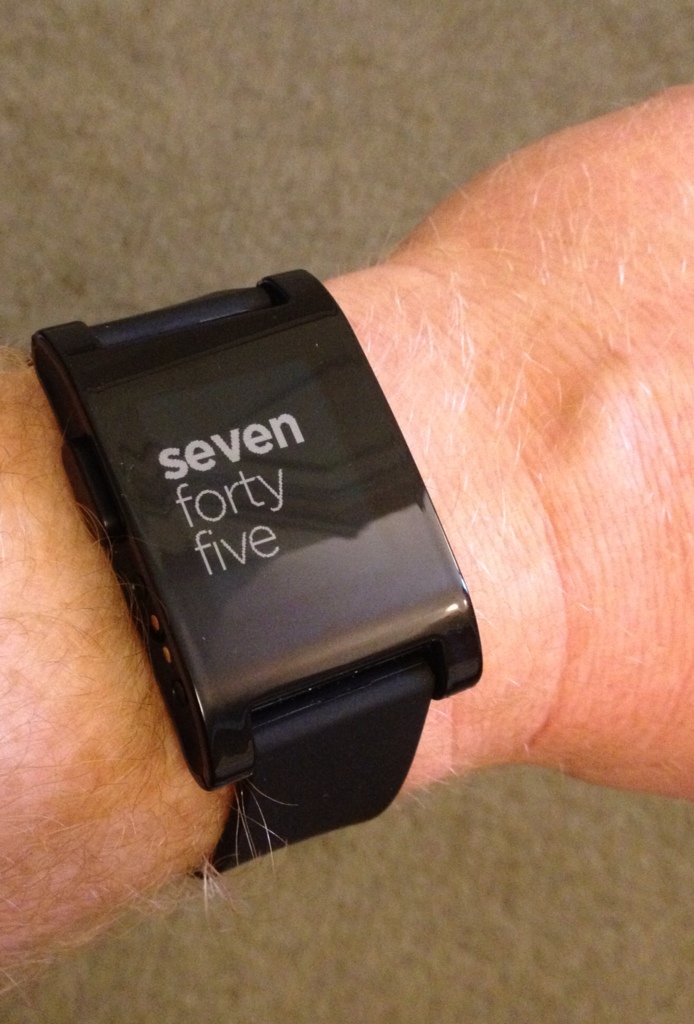 About a year ago, like many thousands of others, I backed the Pebble Kickstarter project. Yesterday, after forking over another 25 quid to the Queen (a combination of the Royal Mail and Her Majesty's Revenue and Customs), I received my new toy.
My first impression was that it looks and feels much nicer than I expected. It's hard to convey this in pictures: I don't think it looks as cheap in reality as the black shiny plasticness of many photos would suggest, and after years of a fine but heavy stainless–steel–and–titanium Citizen, this feels light and comfortable.
At present, there's a limited amount you can do with it. Incoming texts and iMessages are forwarded to it, incoming calls can be accepted or rejected from your wrist, and you can stop or start music and skip backwards and forwards. But there's a buzz of activity on the forums around the newly–released SDK. In just a couple of days, people have contributed range of new watch faces, and, of course, there's already a Tetris and a Pong clone!
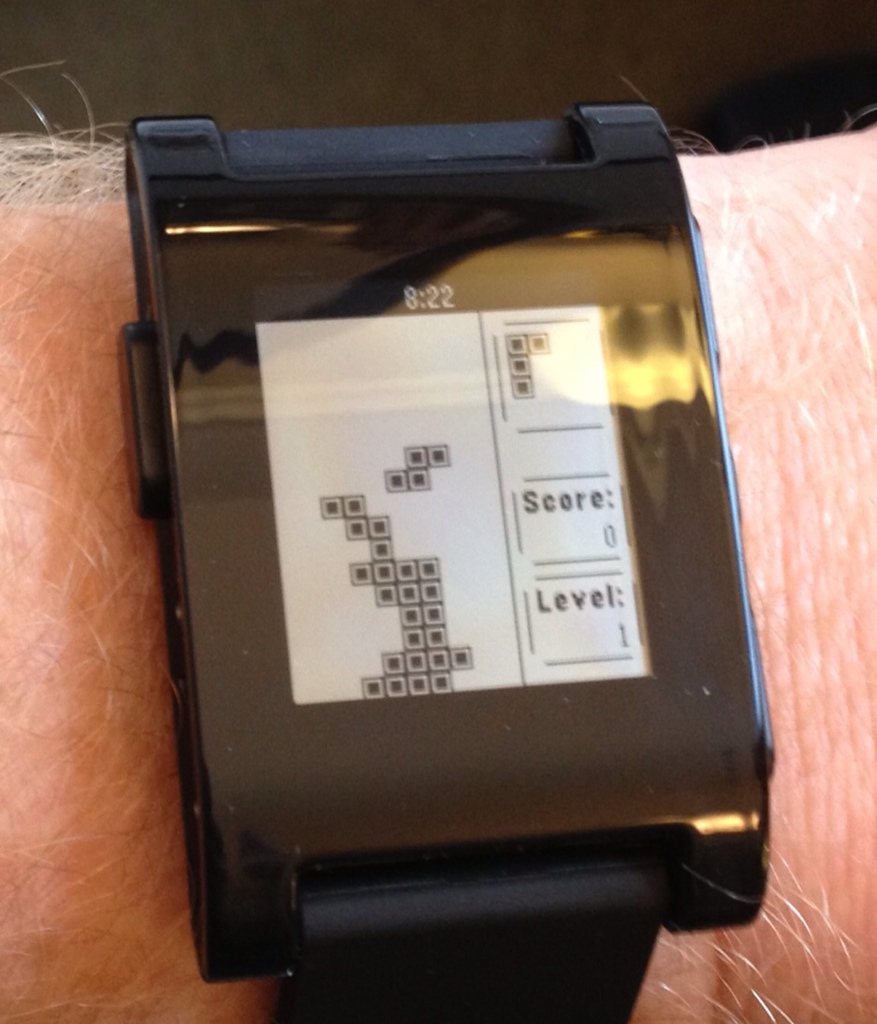 The really interesting apps, though, will depend on the watch's connectivity with your phone, and thence with the outside world. I must have a play with the SDK soon, but I suspect the facilities offered by the phone's Bluetooth APIs will be the limiting factor there, especially on my iPhone.
In the meantime, the ability to stop and start playback of my audiobooks and podcasts is very handy. I tend to put my phone in my breast pocket while walking the dog, so I can listen to things without the need for headphones, but this can make me look a little eccentric to passers-by. Appearances can be deceptive. So being able to stop the audio as someone approaches, simply by pressing a watch button, helps preserve my dignity.
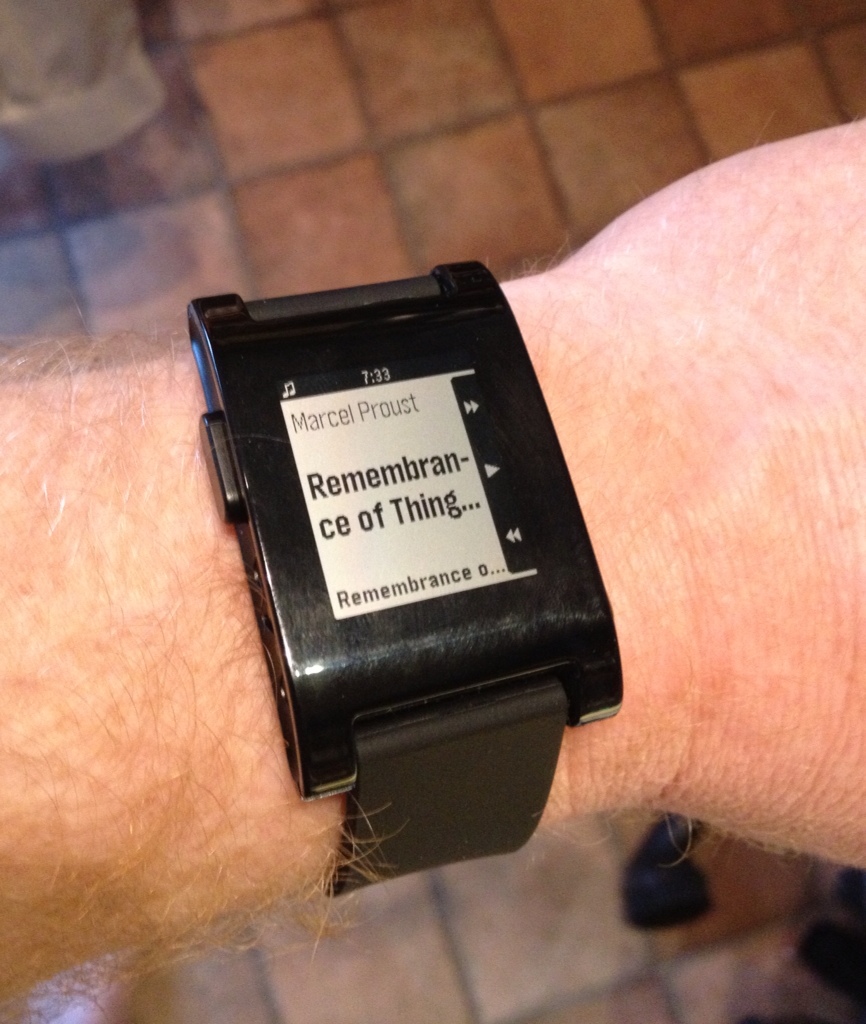 At present, I'm listening to a splendid version of Proust's À la Recherche du Temps Perdus. It seems somehow appropriate.
But I think it's time for a new translation. The title is typically rendered in English as 'Remembrance of Things Past', or -- and this is perhaps poignant for those exploring their watch's user interface -- 'In Search of Lost Time'.
But my upcoming version will be a whole new translation of À la Recherche du Temps Perdus for the modern age, entitled, "In Research, Much Time is Wasted"...
I'm enjoying Remembrance of Things Past, but my expectation of completing the whole thing has been somewhat reduced by my calculating that it's more than one-and-a-half times the length of the Bible.
Fortunately, Marcel Proust is a much better writer than God, but I fear that may not be sufficient...
Here's a gadget I'd really like to have: a programmable in-car graphic equaliser.
My car audio system sounds fine at speeds below about 20mph, but certain parts of the audio spectrum tend to get lost when going faster, and I've never found a car stereo that copes well with this.
Having the volume increase with speed helps a bit, but I'd really like to be able to set equalisation to be reasonably flat when going slowly, and adjust it to boost, say, tenor vocals so that things sound good at 40mph and 70mph. Then it should interpolate between my various settings at intermediate speeds.
Anyone seen anything like this, or should I patent it? :-)
I guess it could be an iPhone app, since most of my audio comes from there, and it has a GPS...
My friend Rob Berwick sent me a kind gift of a Blinkstick. Here's an example of what you can do with it, in this case, by plugging it into a Raspberry Pi.
You can get the Blinkstick as a kit, and solder it together yourself (which isn't difficult) or, for a few quid more, get it ready-assembled.
Some links to other things mentioned in the video:
An IDC press release, out today, reports that PC sales have fallen again. That's expected now, but they've fallen noticeably faster than predicted: the last quarter was a surprising 14% down on the same time last year.
"At this point, unfortunately", says an IDC staff member, "it seems clear that the Windows 8 launch not only failed to provide a positive boost to the PC market, but appears to have slowed the market..." And it's not just Windows – Apple's desktop/laptop sales are down, too.
A big contributor, I'm sure, is that we've finally reached the point where operating system manufacturers and other software developers can no longer convince users that it's worth buying a new machine just to run their latest offerings. I'm currently a software developer, for heaven's sake, and even I am feeling no particular desire to replace my four-year-old iMac in the near future.
But a lot of it also comes from the fact that fewer people need to do, on a regular basis, what PCs were designed to be good at doing.
Phones and tablets don't replace a PC, but if you drew a Venn diagram of
over the last few years, it would resemble a lapsed-time animation of plate tectonics. And my point is that 'What PCs do' would be largely stationary, while the others moved around it in ever-more-overlapping zones...
I write quite a lot, but I use a word-processor about once a month. I manage my company accounts, but much more of that is done on a web service than on a spreadsheet. I give talks, but the days when PowerPoint was the only game in town are long gone. And I read emails... while I'm walking the dog.
So, if I'm at all typical, where does that leave Microsoft Office, the core of most PCs' raison d'être? And remember, I'm an old guy. For most people under the age of 25, it probably never was that important. The office suite is dead, and has been for a long time. Long live the browser. On whatever device.
On which note, I should shut down the browser on this iPad and go to sleep...
Thanks to Charles Arthur for the IDC link
TextExpander is one of the most useful utilities on my Mac -- I've used it since it was called Textpander, many years ago -- and it's becoming more and more important on my iOS devices too, since almost every app I use, with the notable exception of the Apple ones, now supports it. And the configuration synchronises across all my devices automatically, making things even easier.
It's arguably more useful on iOS, where it can help overcome some of the limitations of the keyboard. Typing email addresses can be tedious, for example, so I have three-letter abbreviations for most of mine. (Simple expansions like this can also be done using the built-in keyboard shortcuts available in Settings, which will work anywhere, but they don't have the power of the TextExpander ones.)
A current favourite example, since I'm writing more and more in Markdown, is my .mdl abbreviation. It inserts a Markdown link, taking the contents of the clipboard as the URL (which I've typically just copied using the little 'share' button in Safari), and positions the cursor at the right place to type the link text. A link in Markdown, for the uninitiated, looks like this:
[Status-Q](http://statusq.org)
If you work out how many key presses are needed on a standard IOS keyboard just to do the brackets, you'll realise that, though this is already a lot better than writing HTML, to do the equivalent with just .mdl and have it position the cursor in the right place, is a great help if you do it regularly. Which I do!
All very clever, and a great timesaver. But today I added a very simple abbreviation, vvv, which also makes use of the 'insert the clipboard here' capability. In fact, that's all it does: as soon as you type the third v, all three are replaced by the contents of the clipboard, a bit like typing Cmd-V on a regular keyboard. I find this rather easier, particularly in small text boxes on a phone screen: to have a keyboard-based paste function, instead of having to move from the keyboard and tap carefully in the right place, with the right precision and timing not to select anything.
It really is too bad the Apple apps don't support it, but I hope it may be useful for others anyway.
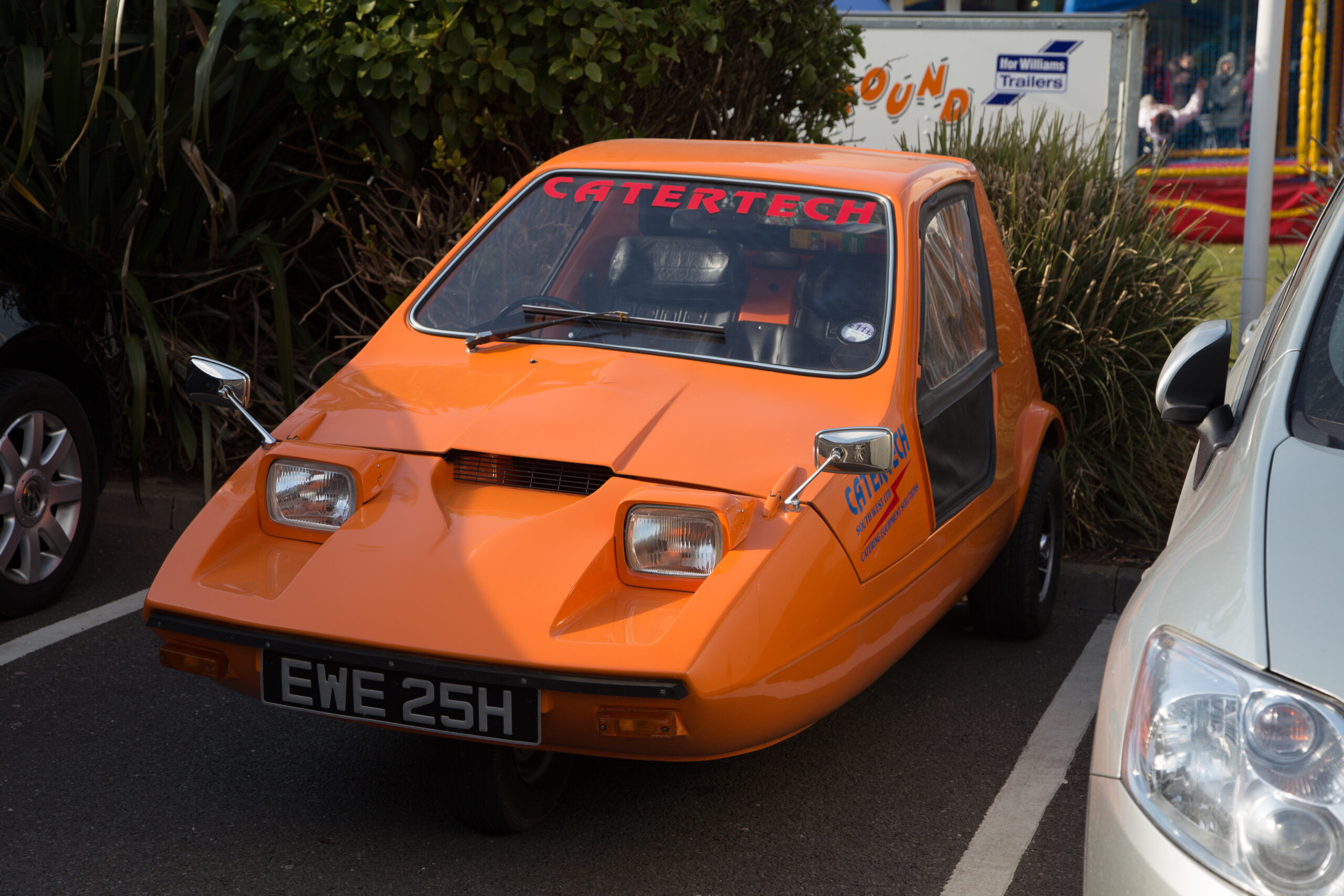
Spotted in Ilfracombe last week. I used to think Bond Bugs were so cool when I was young.

At Baggy Point, near Croyde, Devon
On the way home from Devon, to avoid a nasty M4 traffic build-up near Swindon, we stopped off at Lacock, a small Wiltshire village owned almost entirely (and beautifully preserved) by the National Trust.
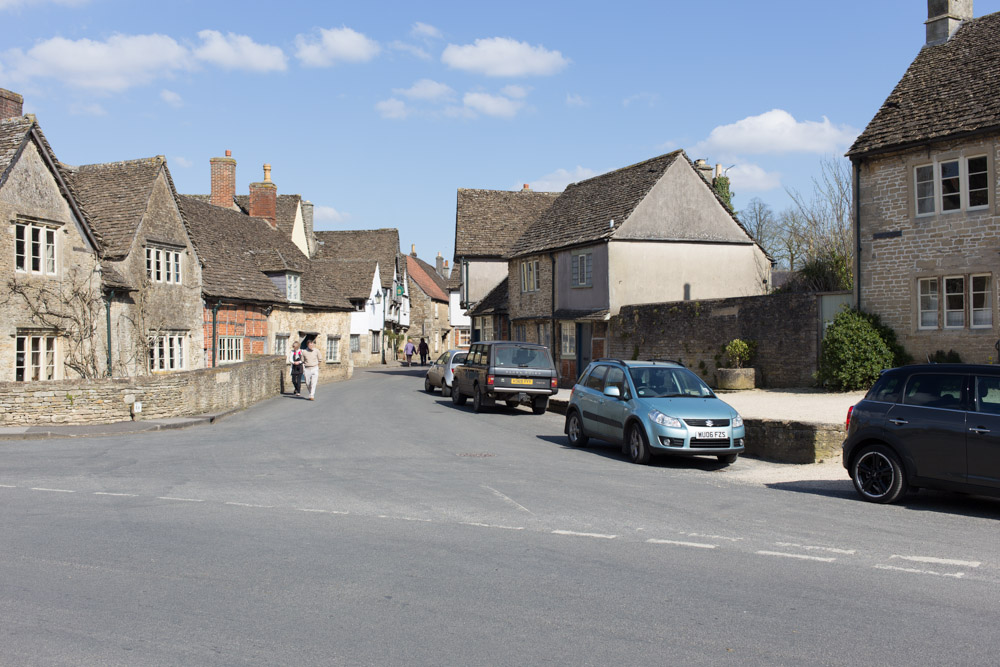
On the sunny afternoon after a bank holiday, it was a very peaceful spot, and a delightful antidote to the M4. (Or to Swindon).
Lacock is used as a location for many films - we recognised several bits of Meryton from the BBC's Pride and Prejudice, for example. But it also has an important place in photographic history, because a window at Lacock Abbey was the image Henry Fox Talbot captured in the first known photographic negative.
As we drove home, I couldn't help wondering what Henry F T would have made of Glenn Morse's very cool project to build a photographic enlarger. This is no ordinary enlarger, though - the negatives are their own light source, because they're displayed on his iPad screen.