
Category: General

Listening for the word

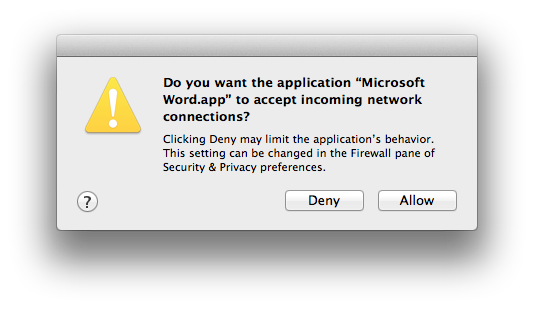
Since I turned on my Mac's firewall a few months ago, I get occasional messages which cause me to wonder:

Now, I can understand why Word might want to make outgoing connections, to check for version updates, to print, etc. Anyone know why it would want to be listening on my network? It works just fine if you say no, but I am curious...

The other revealing thing, for me, was that I only saw this message today, which means I haven't used Microsoft Word for more than four months. This time, as is usually the case, I only need to run it when I'm sent something by a lawyer.

FreeAgent

Here's a quick and unsolicited recommendation. When I first set up Telemarq, I was looking for some accounting software that I could use on my Mac, since MYOB, of which I was rather fond, is no longer in existence.

I tried GnuCash, which is free, and now really quite good. I used Ledger for a bit, which is splendid if you're a geek who likes everything in text files. Both of these gave me a lot of control, but they also swallowed a great deal of my time.

Friends suggested I should look at cloud-based offerings, and after experimenting with a few I came across FreeAgent.

I was, I must admit, rather hesitant about this. As a limited company, albeit a very small one, we needed to pay their top rate of £25/month plus VAT. A total of £360 per year. That's quite a lot for accounting software in a small company. (If anyone decides to try it as a result of this post, please click this link and you might save me a few pennies!).

In addition, I understood 'real' double-entry bookkeeping, and this hid a lot of that behind the scenes, so it couldn't be a real accounts package, could it?

Well, several months on, I just love it. It saves me a huge amount of time - much more than 30 quid's worth per month, I suspect - does almost everything I need, and is very UK-oriented (so it tells me when my VAT returns and annual company returns are due). It produces nice invoices and send them to our clients, along with links for electronic payment options if they want to use them. It's very good at importing my bank statements with minimal manual intervention, it makes submitting VAT returns a breeze, and on the rare occasions when I've contacted support, they've been very prompt and helpful.

Finally, there's a good API, and various apps for smartphones which make it really easy to log expenses and timesheets.

There are some things I'd like changed: I wish the pricing was a bit more competitive for small companies, I wish they offered a low-cost 'personal' version because I'd like to use it on my own accounts, I'd like a few more options when configuring invoices... but all in all, it comes highly recommended.

Love and marriage, love and marriage...

...go together like a RaspberryPi and Veroboard...

"The thing people don't understand about weddings", said a perceptive friend once, "is that they think it's 'the bride's special day'. When in fact, of course, it's usually the bride's mother's special day. It's when she gets to create the wedding for her daughter that she wishes she'd had herself. And she'll be able to remember the details of this one."

The male equivalent is probably buying a model railway set "for the benefit of your children". Or, at least, it used to be. Now, of course, geeks of my generation are terribly keen to support the RaspberryPi, "because of all its educational benefits".

I was thinking about that this morning as I soldered transistors onto Veroboard... for the first time in about 30 years. It's for the educational benefit of my dog...

How to... ahem... disseminate your advertising materials

An intriguing article by Charles Duhigg, published a few months back in the New York Times magazine, talks about the value to large retailers of knowing when their customers are pregnant:

There are, however, some brief periods in a person's life when old routines fall apart and buying habits are suddenly in flux. One of those moments -- the moment, really -- is right around the birth of a child, when parents are exhausted and overwhelmed and their shopping patterns and brand loyalties are up for grabs. But as Target's marketers explained to Pole, timing is everything. Because birth records are usually public, the moment a couple have a new baby, they are almost instantaneously barraged with offers and incentives and advertisements from all sorts of companies. Which means that the key is to reach them earlier, before any other retailers know a baby is on the way. Specifically, the marketers said they wanted to send specially designed ads to women in their second trimester, which is when most expectant mothers begin buying all sorts of new things, like prenatal vitamins and maternity clothing. ""Can you give us a list?"" the marketers asked.

Well worth reading the whole thing. Gives a whole new ring to the phrase ‘targetted advertising’!

Learning from the disaster

Most of you have probably heard by now about how the technology reporter Mat Honan's accounts were hacked and how he lost his Google Mail, his Apple and Amazon account, his Twitter account and the contents of his iPhone and laptop. All in under one hour.

What's fascinating about this story is that we know how it was done: there was no heavy brute-force attack on weakly-encypted passwords, no SQL injections on his company's website. The hackers had no animosity towards him; they didn't know who he was, they just liked his three-letter @mat Twitter ID. In other words, this could easily happen to you too!

If you haven't heard the story, then I recommend listening to episode 364 of Security Now, which you can get from here or here. The discussion starts 30 mins into the programme.

You should probably listen to this if you, say, use the Internet...

Organisations don't think, people do

"Can we arrange a time for a conference call with you?", said the enthusiastic email that landed in my inbox last year from some company's marketing department. "We're very excited to tell you about our new viral videos!"

To which my response, of course, was that if they were really viral, they wouldn't need to tell me about them!


I thought of this while watching Euan Semple's keynote from the State of The Net conference in June, which, in contrast, has a gentle, understated style yet includes some nice ideas that come from years of careful thinking about corporate communications, both internal and external.


Euan Semple is the author of Organizations Don't Tweet, People Do.